

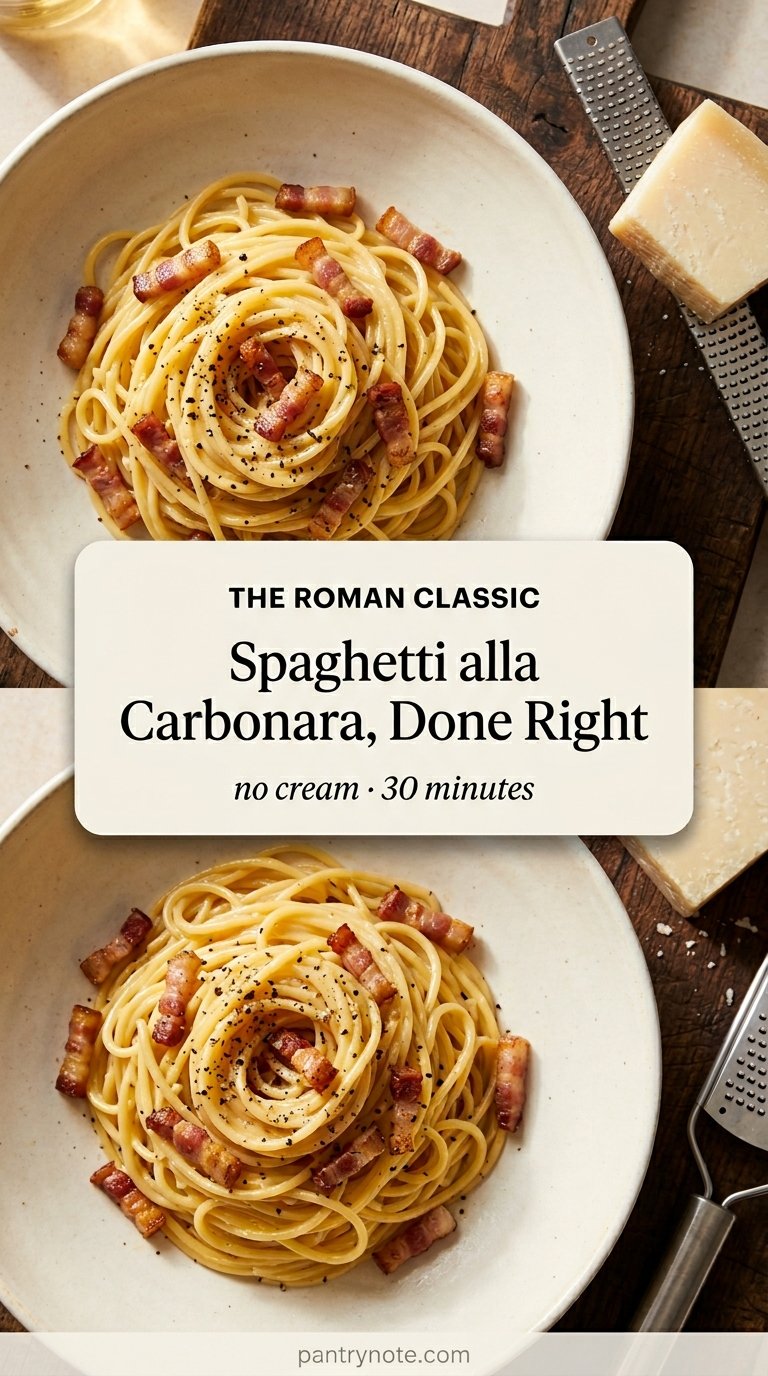
Spaghetti alla Carbonara, Done Right
Carbonara has been through a lot. Cream-based versions, bacon substitutes, garlic additions, the whole sad American "carbonara" landscape. But the real thing — Pecorino, guanciale, eggs, pepper, pasta water — is so much better than any of those approximations that it's worth learning the actual technique.
Let's establish something first: real carbonara contains no cream. No garlic, either.
No peas, no mushrooms, no parsley. The Roman tradition is strict about this and strict for good reason: the dish is already perfect with four ingredients (five if you count the pasta), and everything added to it dilutes rather than improves.
Spaghetti alla carbonara is Rome's great contribution to the pantheon of pasta dishes: a silky, intensely savory, eggy sauce that coats every strand through emulsification rather than reduction, flavored with the rendered fat of guanciale and an aggressive hand with the black pepper. Getting it right requires understanding one technical point: the eggs must never scramble.
The sauce should be creamy and flowing, not curdled. Everything else follows from solving that problem.
This is the pasta I make when I want something that tastes expensive but costs almost nothing. Guanciale, Pecorino, eggs, spaghetti, black pepper: the whole dish costs maybe six dollars and produces something you'd happily pay twenty-two for in a restaurant.
Why this works
The sauce in carbonara is an emulsion, specifically a suspension of fat droplets in a water-based liquid (the pasta cooking water), stabilized by the lecithin in egg yolks and the proteins in the egg whites. When this emulsion is successful, you get a smooth, creamy sauce that clings to the pasta. When it fails, the egg proteins coagulate at too high a temperature and you get scrambled eggs.
Egg proteins begin to denature (uncoil from their folded structure) at around 140°F and coagulate (clump together and solidify) starting at around 149°F for yolks and slightly higher for whites. The goal is to use the residual heat of the hot pasta and the warm guanciale fat to bring the egg mixture to the temperature range where the proteins are coating and thickening but not curdling. This window is narrow, perhaps 10°F, and the way to stay in it is to work quickly, keep the pasta moving constantly, and use the pasta water as a temperature buffer.
Pasta water is the secret weapon. It's not just water; it's a starchy, slightly salty liquid that contains dissolved pasta starch from cooking.
This starch contributes to the viscosity of the sauce and, critically, the starchy water can be added in increments to cool the mixture slightly if it's getting too hot, or to loosen the sauce if it's getting too thick. The pasta water is your safety valve.
Guanciale (cured pork cheek) is fattier than pancetta and has a different fat profile: the fat renders at a lower temperature and has a softer, more luscious texture when cooked than the firmer fat of pancetta. The rendered guanciale fat becomes the base of the sauce; the residual heat of the pan and the fat itself contribute to cooking the egg mixture at the right temperature.
Ingredient notes
Guanciale
This is the correct ingredient. Pancetta is the acceptable substitute: it's also cured pork, just from the belly rather than the cheek, with a firmer texture and slightly different flavor.
Regular bacon is the last resort; it's smoked, which adds a flavor that doesn't belong in carbonara. Seek out guanciale at Italian specialty stores or online; Olli and La Quercia both ship good domestic versions.
Pecorino Romano
Aged, salty, sharp sheep's milk cheese. Real carbonara uses Pecorino, not Parmesan.
Some Romans use a mixture, half Pecorino, half Parmigiano-Reggiano, to moderate the sharpness. But if you're only using one, it should be Pecorino.
Grate it yourself on a microplane, since pre-grated cheese contains anti-clumping agents that affect sauce texture.
Eggs
The ratio that works reliably: 2 whole eggs plus 2 additional yolks per 100g of dried pasta. More yolks = richer and more sauce; fewer = thinner coating.
Room temperature eggs incorporate more smoothly. Take them out of the fridge 30 minutes before cooking.
Black pepper
Freshly ground, coarsely, not fine dust. Toast the peppercorns briefly in a dry skillet before grinding if you want maximum impact. The pepper should be aggressive enough to actually register as a flavor, not a background note.
Spaghetti
Spaghetti or rigatoni are the traditional shapes. Rigatoni's ridges hold more sauce.
Bucatini is excellent here: the hollow center traps sauce. De Cecco makes excellent dried pasta consistently available at a fair price.
How to make it
Get everything ready before you start. Carbonara is fast and doesn't wait. Grate your cheese, bring your eggs to room temperature, have a ladle next to your pasta pot, and have a large bowl ready (a metal or ceramic bowl, not plastic, since it needs to hold heat).
Cut the guanciale into lardons: small, chunky batons about a centimeter thick. In a wide skillet over medium heat (no added fat), let the guanciale render slowly, stirring occasionally.
You want the fat to run clear and the meat to become golden and slightly crispy, about 10 minutes. Don't rush this.
Turn off the heat when done but leave it in the pan; you'll use the residual heat.
In the bowl, whisk together the whole eggs, yolks, most of the grated Pecorino, and the cracked pepper. Whisk until smooth and slightly pale.
Cook the spaghetti in aggressively salted water (tastes like mild seawater, around 1 tablespoon salt per 4 cups water) until al dente. Reserve at least a cup of pasta water before draining.
Here's the critical moment: drain the pasta and immediately add it to the skillet with the guanciale (heat off). Toss to coat.
Now add about a quarter cup of the reserved pasta water to the egg mixture and whisk to combine. Pour the egg mixture over the hot pasta in the pan.
Toss constantly and vigorously with tongs for about 60 seconds. The sauce should begin to thicken.
Add pasta water in tablespoon increments if it thickens too fast or clumps. You're looking for a silky, flowing coating that's not liquid but not stiff.
Serve immediately in warm bowls. More Pecorino. More pepper.
Tips and variations
Temperature control
If your sauce is scrambling, you moved too fast or the pan was too hot. Take the pan off the heat entirely, add a splash of cold pasta water, and toss quickly. The water drops the temperature.
Rigatoni carbonara
Rigatoni's ridged exterior and tubular shape hold significantly more sauce per bite. Many Romans prefer it. The technique is identical.
Scaling
Carbonara scales perfectly. Just maintain the ratio: 2 eggs + 2 yolks per 100g pasta per 2 servings, and adjust guanciale accordingly.
Vegetarian carbonara
Substitute smoked, diced mushrooms (shiitake or maitake, cooked until very dark and chewy) for the guanciale. You'll need to add a tablespoon of olive oil to the pan since mushrooms render less fat. The flavor is different but interesting.
Storage
Carbonara does not reheat successfully. It will scramble or dry out. Make only as much as you'll eat immediately.
Frequently Asked
Why does my carbonara always scramble?
Can I use bacon instead of guanciale?
How much salt should my pasta water have?
Can I reheat leftover carbonara?
 Save
Save
0 Comments
No comments yet — start the conversation below.