

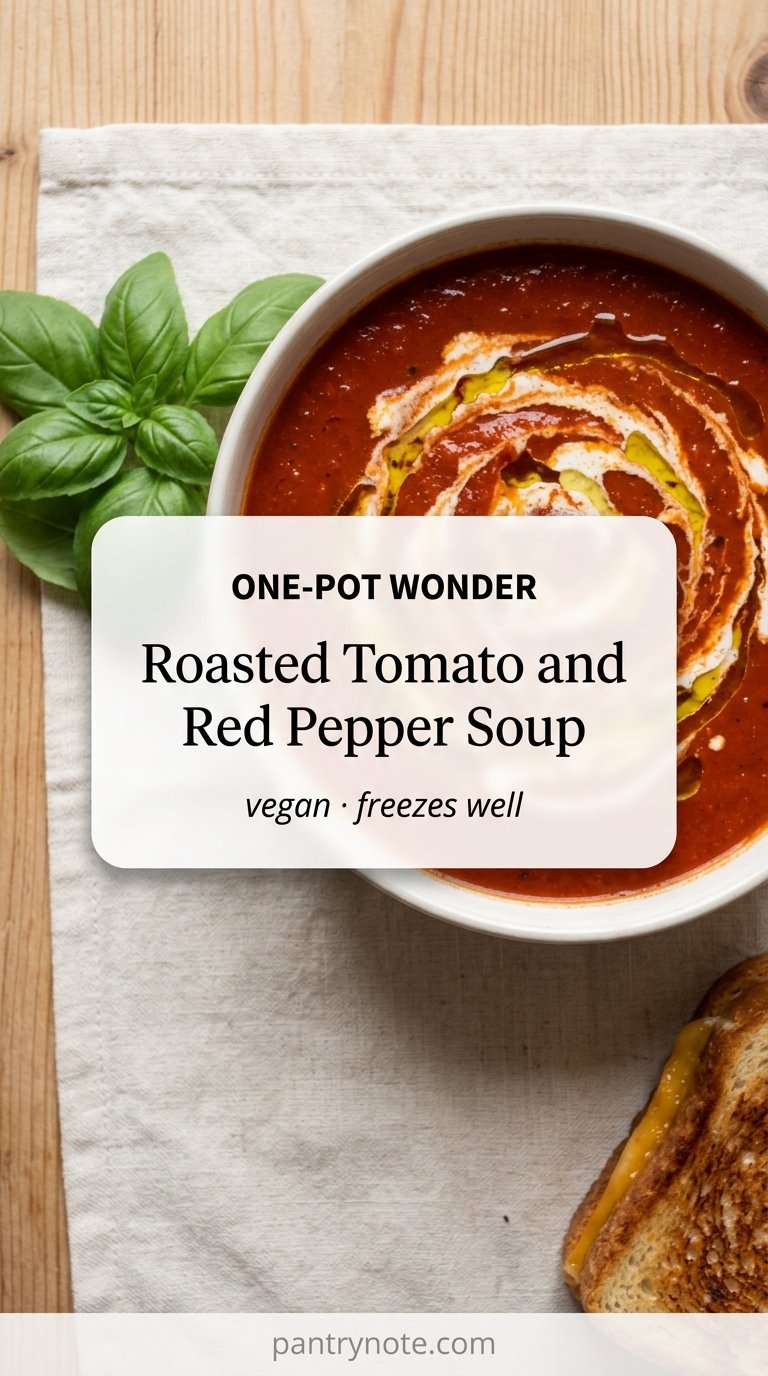
Roasted Tomato and Red Pepper Soup
Roasting the tomatoes and peppers before blending is the step that separates this soup from the kind you open from a can. The oven concentrates their natural sugars and adds a slight char that gives the finished soup a depth that no amount of stovetop cooking replicates.
There's a school of thought that says soup is something you make from scraps, from the odd vegetables at the back of the crisper, from bones and odds and ends. I believe in that school of thought deeply.
But there's also a soup that you plan for and shop for specifically because it's so reliably good that it justifies its own trip to the market. This is that soup.
Roasting before blending is the technique that matters here. Most tomato-based soups are made by sweating aromatics, adding canned tomatoes, and simmering, a process that produces a perfectly good soup. Roasting the tomatoes and peppers first adds an entirely different dimension: the oven concentrates their sugars (Maillard and caramelization on the cut faces), creates a slight char at the edges that blends into a smoky undertone, and evaporates a significant amount of water, intensifying flavor before you've added a single other ingredient.
The result is a soup so red it looks like it should be served in a museum, silky from the blended pepper skins, sweet from the concentrated tomato sugars, and with a depth of flavor that tastes like it involved a ham hock and three days of simmering when it actually took forty-five minutes.
Why this works
Tomatoes are roughly 95% water by weight. When you roast them at high heat, that water converts to steam and escapes, concentrating the remaining sugars, acids, and flavor compounds into a smaller volume. A roma tomato halved and roasted for 45 minutes loses about 40% of its weight, and every remaining bit is more intensely tomato than when it started.
The Maillard reaction and caramelization both occur on the cut surfaces of tomatoes and peppers during roasting. Maillard produces hundreds of flavor compounds from the amino acids and reducing sugars in the vegetable; caramelization converts sucrose into a range of compounds with toasted, nutty, and slightly bitter notes. Both reactions contribute complexity that steaming or simmering can't replicate.
Red bell peppers bring their own chemistry. They contain significantly more vitamin C and carotenoids than green peppers (the compounds responsible for their red color), and these carotenoids contribute sweet, fruity flavor notes when cooked.
Roasting also softens the cellulose structure of the peppers dramatically, making them blend smoothly. The skins, which are normally chewy, soften enough in the blender that they contribute both color and body.
A final splash of sherry vinegar, added at the end rather than during cooking, provides acidity that brightens the entire flavor profile. Acids added to sweet, roasted vegetable soups do the same work that salt does in general: they make the other flavors more vivid by providing contrast.
Ingredient notes
Tomatoes
Roma (plum) tomatoes are ideal for roasting: they have less water and more flesh than round tomatoes, which means more concentrated flavor per pound and less time in the oven. If you're making this in summer with excellent ripe heirloom tomatoes, use those; the quality will be extraordinary. Canned whole San Marzano tomatoes can substitute in winter: drain them, spread on the sheet pan, and reduce roasting time to 25–30 minutes.
Red bell peppers
Roasting your own peppers from fresh is worth it here for texture. Two large red peppers, halved and seeded. The charred skin adds the smoky undertone that makes this soup interesting: leave a bit of char on the peppers when you peel them (or don't peel them at all before blending, since the small amount of charred skin rounds out the flavor).
Smoked paprika
A teaspoon added to the aromatics deepens the smoky note from the roasted peppers. Not essential, but excellent.
Good canned whole tomatoes
If fresh are unavailable or out of season, San Marzano DOP canned tomatoes are the benchmark. They're sweeter, less acidic, and have fewer seeds than most domestic canned tomatoes. Muir Glen is an excellent American alternative.
Stock
Vegetable stock keeps this vegan. Chicken stock makes it slightly richer and more savory. The choice matters less here than in soups where the stock is more prominent, since the roasted vegetables are so flavorful that the stock is mainly adding volume.
How to make it
Preheat to 400°F. Halve the roma tomatoes lengthwise and the bell peppers, removing seeds and stem.
Place everything cut-side up on sheet pans; don't crowd them. Drizzle generously with olive oil, scatter some salt over, and roast for 40–45 minutes until the tomatoes are deeply colored and slightly shrunken and the peppers are soft and beginning to char at the edges.
Meanwhile, sweat a diced onion and four cloves of garlic in olive oil in a large pot over medium heat, just until soft and translucent, about 8 minutes. Add a teaspoon of smoked paprika and cook another minute.
Scrape all the roasted vegetables (skins, juices, everything on the pan) into the pot. Add vegetable stock to just cover. Simmer for 10 minutes to let everything meld.
Then blend until smooth: an immersion blender works well for chunky results; a regular blender gives a silkier finish. Blend in batches if using a stand blender, never filling more than halfway (hot liquids expand).
Return to the pot, adjust seasoning: it will need more salt than you expect. Add a splash of sherry vinegar.
Taste again. The vinegar should not be detectable as vinegar; it should just make everything taste more alive.
Finish with a drizzle of olive oil and, if you have it, a small swirl of crème fraîche or plain yogurt.
Tips and variations
Add bread: Stir in torn day-old bread (crusty bread, no crust required) during the final simmer. It dissolves into the soup, adding body and a hearty quality. This is essentially a pappa al pomodoro move applied to a roasted pepper soup.
Make it spicy
A dried ancho chile or a chipotle pepper in adobo added with the aromatics gives the soup a Mexican-adjacent character: smoky, fruity, and hot.
Freeze it
This soup freezes beautifully for up to 3 months. Portion into quart containers. Thaw in the fridge overnight.
Serve cold
Chilled tomato and pepper soup is essentially a more textured gazpacho. Works wonderfully in summer with good bread.
Add cream
A quarter cup of heavy cream stirred in after blending makes this a fully luxurious affair. A couple of tablespoons of butter stirred in at the end also adds richness.
Frequently Asked
Can I use jarred roasted peppers to save time?
How do I safely blend hot soup?
How long does this soup keep?
Can I make this into a full meal?
 Save
Save
0 Comments
No comments yet — start the conversation below.