

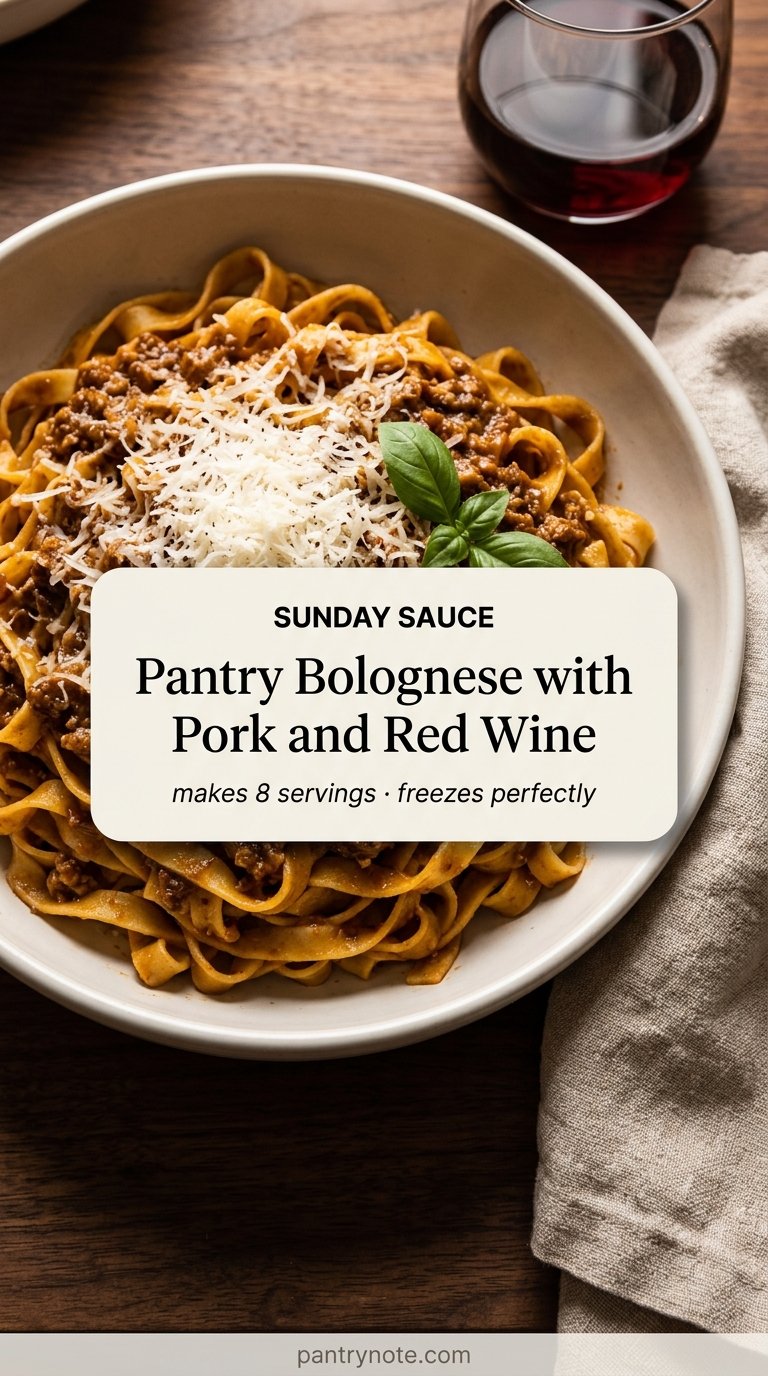
Pantry Bolognese with Pork and Red Wine
Bolognese is not a sauce you throw together on a weeknight, and it shouldn't try to be. The slow simmer — two hours minimum, three is better — is what transforms ground pork and aromatics into something that belongs alongside the greatest pasta dishes in any tradition. Make it on a Sunday and eat it four ways through the week.
The first thing to understand about Bolognese is that it is not a tomato sauce. This might seem pedantic, but it changes how you cook it fundamentally.
A proper ragù alla Bolognese is a meat sauce: one in which meat is the subject and tomato is a supporting ingredient, used in small quantity for acidity and color rather than as the dominant flavor. The milk is not a trick; it's essential.
The wine is not optional. And the time is the whole point.
This version uses ground pork as the primary meat rather than the traditional veal or beef-and-pork combination. Pork has more fat than lean ground beef, and fat is flavor in a meat sauce: it lubricates the sauce, carries the aromatic compounds, and keeps the meat tender through a long simmer rather than turning chalky and dry. It's also cheaper and more widely available than veal.
I make a large batch of this on a Sunday afternoon; the smell alone is worth it, a slow drift of wine and meat and soffritto that makes the whole apartment feel like somewhere worth being. And then I eat it over four days in four different forms: with tagliatelle the first night, folded into a lasagna the second, stirred into a cannellini bean soup on day three, and used to top polenta on day four.
Why this works
The soffritto is where flavor development begins. Equal parts onion, celery, and carrot, cooked slowly in butter and oil until soft, sweet, and nearly dissolved (not browned aggressively, just coaxed into releasing their sugars and building a sweet, complex base).
This takes longer than most recipes suggest. Twenty minutes over medium-low heat is appropriate; ten minutes is not enough.
The meat browning is where most cooks go wrong with Bolognese. The ground pork should be added to the pan in portions and allowed to brown without being moved: if you add it all at once and stir immediately, the meat steams in its own moisture and you lose the Maillard browning that contributes so much to the final flavor.
Add meat in batches, let it color on one side, then stir. This extra time is paid back exponentially in flavor.
The milk addition is one of the more counterintuitive steps in Bolognese, but its purpose is specific: the proteins in milk interact with the meat's proteins during long simmering, tenderizing the texture and contributing a mild richness. More importantly, the lactose in milk moderates the acidity of the wine and tomato, giving the sauce a rounder, less sharp flavor. Traditional Bolognese from Bologna adds milk; this is not an invention, it's the original recipe.
The wine deglaze after the meat removes all the fond, the deeply flavorful browned bits stuck to the pan, and adds complex aldehydes and tannins from the wine that can't be replicated with any other liquid. Red wine reduces into the sauce, leaving behind those compounds.
Then a very small amount of tomato paste or crushed tomatoes is added, a quarter cup maximum. This is accent, not base.
Long simmering (2–3 hours at a bare simmer) breaks down collagen in the connective tissue of the ground meat into gelatin, which gives the sauce its silky, slightly sticky texture. This is the same process at work in braised short ribs or oxtail. Time is the ingredient.
Ingredient notes
Ground pork
80% lean. Avoid extra-lean ground pork: the fat is what makes this sauce silky rather than chalky. If you can find coarsely ground pork from a butcher, the texture will be superior to the fine grind from a supermarket package.
Soffritto vegetables
Equal weight of onion, celery, and carrot. The carrot adds sweetness, the celery adds a slightly green, vegetal note, and the onion forms the base. Dice them very finely; larger pieces won't fully dissolve into the sauce.
Whole milk
Not low-fat, not cream. The protein content of whole milk is what matters here, along with its moderate fat. Heavy cream can substitute for extra richness, but it changes the flavor profile.
Red wine
A full-bodied, dry red. Chianti, Barbera, or any inexpensive Sangiovese-based wine.
Avoid sweet reds. You don't need to open a bottle you'd serve to guests, since the wine's role is primarily chemical, not gustatory, but don't use something you wouldn't drink.
Tomato paste
One or two tablespoons, bloomed in the oil before the meat goes in. This concentrates the tomato flavor further and adds color. Some versions of Bolognese use no tomato at all; this is a moderate approach.
How to make it
Melt butter and olive oil together in a large, heavy-bottomed pot or Dutch oven over medium-low heat. Add the finely diced soffritto and cook, stirring occasionally, for 20–25 minutes until completely soft, sweet, and barely beginning to turn golden. Add a tablespoon of tomato paste and cook, stirring, for 2 minutes until it darkens slightly.
Increase heat to medium-high. Add the ground pork in three batches, letting each addition brown on one side before stirring.
Season each layer with salt. This step takes 10–12 minutes total.
Add the whole milk. Stir and let simmer until the milk has mostly absorbed and evaporated, about 10 minutes.
Then add the red wine. Let the wine reduce by half, another 8–10 minutes.
Add a small amount of crushed tomatoes or a half cup of water or stock. Lower heat to the barest simmer.
Add a bay leaf and a pinch of nutmeg (the nutmeg is traditional, use it). Partially cover and cook for at least 2 hours, preferably 3, stirring every 20–30 minutes and adding a splash of water if it becomes dry.
The finished sauce should be thick, not liquid, with the fat separated slightly at the edges (this is correct). Season carefully and serve over fresh tagliatelle with abundant Parmigiano-Reggiano.
Tips and variations
Make it ahead
This sauce is better the next day. The flavors integrate and the texture improves. Make it Sunday, refrigerate, skim off the solidified fat cap if desired (or stir it back in), and eat it Monday through Thursday.
Freeze it
Bolognese freezes perfectly for up to 3 months. Portion into 2-cup containers. Thaw overnight in the fridge.
With tagliatelle
The traditional pairing and the right one. Fresh tagliatelle is ideal.
Dried pappardelle is a close second. Don't use spaghetti or angel hair; the sauce is too hearty for thin pasta.
Make a lasagna
Layer the cooled Bolognese with béchamel and lasagna sheets. This is the finest use of leftover Bolognese.
Add chicken livers
100g of chicken livers, cleaned and chopped finely, added with the meat, melt into the sauce during the long simmer and add enormous depth without being identifiable as liver in the final dish.
Frequently Asked
Why is my Bolognese watery?
Can I make this in an Instant Pot?
What pasta shape is traditional with Bolognese?
Can I freeze this sauce?
 Save
Save



0 Comments
No comments yet — start the conversation below.