

Baked Mac and Cheese with Breadcrumb Crust
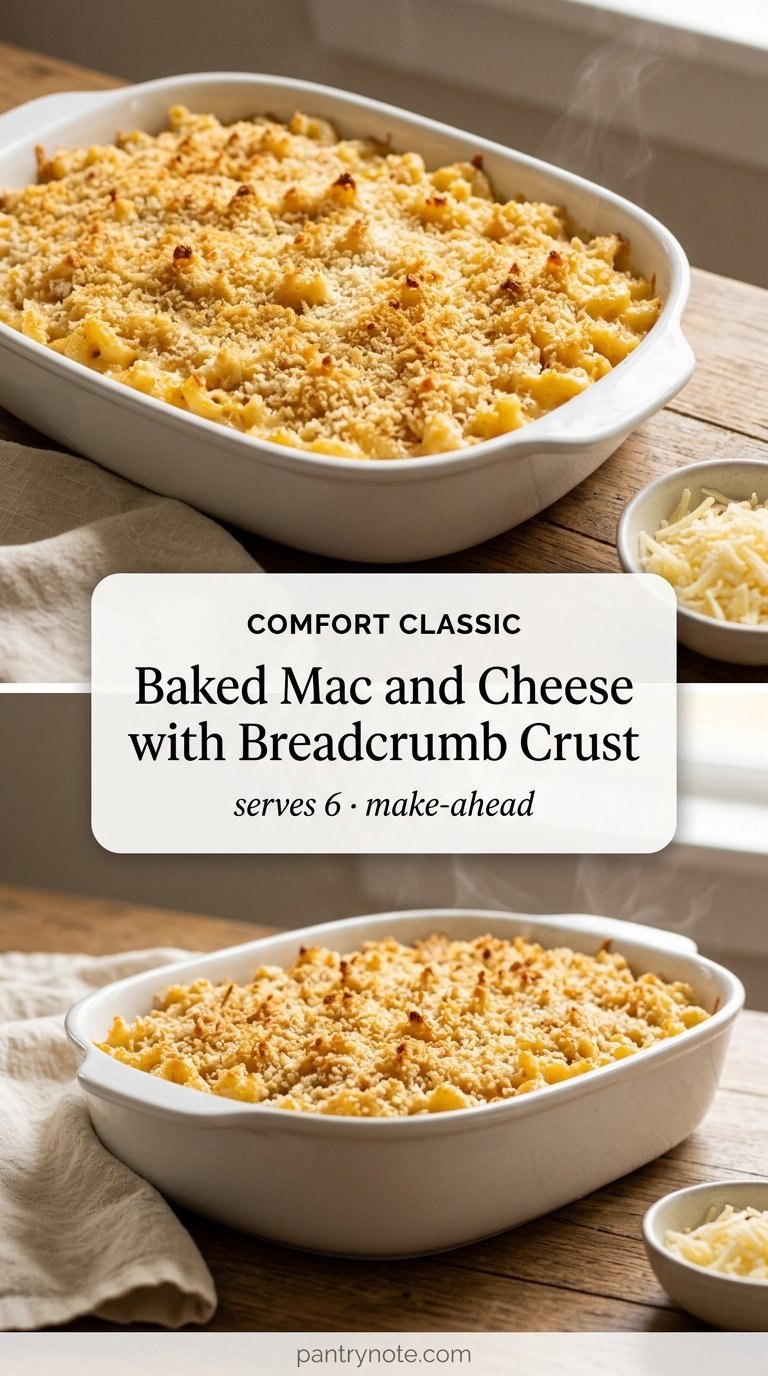
This is the mac and cheese that makes people ask for the recipe before they've finished their first bowl. It starts with a proper béchamel, gets three kinds of cheese, and goes under the broiler with a panko crust that shatters when you press a spoon through it.
Baked Mac and Cheese with Breadcrumb Crust
There is a version of mac and cheese made from a blue box that has its place in the world; I won't argue otherwise. But this is not that. This is the one you make when you want something that tastes like it took more effort than it did, the one you bring to a potluck and come home with an empty dish, the one that turns a Tuesday into something worth sitting down for.
The version I'm giving you is built on a proper béchamel: a cooked butter-flour roux thinned with warm whole milk. From there it picks up three cheeses, a hit of dry mustard, and a pinch of cayenne that you'll never taste on its own but will absolutely notice if you leave it out.
The pasta gets folded in, the whole thing goes into a baking dish, and a layer of panko breadcrumbs mixed with browned butter lands on top before it hits the oven. When it comes out, the top is shatteringly crisp and the inside is still molten enough that it pools when you spoon into it.
This feeds six generously, eight if there are other things on the table. It reheats beautifully, better than almost any baked pasta I can think of, and it's the rare dish that is genuinely more delicious the next day, which makes it ideal for cooking ahead.
Why this works
Mac and cheese fails in two distinct ways, and understanding both tells you everything about why this recipe succeeds.
The first failure is a sauce that breaks. When you melt cheese directly into hot liquid without a starch foundation, the proteins seize and the fat separates into greasy pools.
The fix is the béchamel: a cooked flour-and-butter paste that acts as an emulsifying scaffold. The starch molecules absorb water and swell, creating a network that keeps fat suspended in the sauce rather than letting it pool out.
When you add cheese to this base, you're introducing it to a protected environment where the proteins warm gently rather than tightening under direct heat.
The second failure is a dry, gluey bake. Many recipes have you cook the pasta fully, mix it with a normal-proportioned sauce, and bake; the result is that the pasta absorbs all the liquid in the oven and the sauce turns to paste.
The fix is two-part: undercook the pasta by two full minutes (it will finish in the oven), and make the sauce noticeably looser than you think it needs to be. It should look almost too saucy when you assemble.
By the time it bakes for 25 minutes, it will be exactly right.
The cheese blend matters here. Sharp aged cheddar is the flavor backbone: it has the depth and slight funk that mild cheddar lacks.
Gruyère adds a nuttiness and a particularly good melt quality thanks to its moderate moisture content. A small amount of cream cheese might seem odd, but it contributes a velvety smoothness and helps the sauce stay creamy even after baking, since its high fat and low moisture content resist the drying effect of oven heat.
The panko crust is the final piece. Regular breadcrumbs compact and go powdery; panko stays flaky and light because of how it's produced: ground from crustless bread into larger, airier flakes that absorb less oil and maintain more surface area. Toasting the panko in browned butter before it hits the top of the dish means it arrives at the oven already halfway to golden, so it crisps fully without over-baking the pasta beneath.
Ingredient notes
Pasta shape
Cavatappi or elbow are the classics for a reason: their curves and ridges trap the sauce inside as well as out. Large shells work too.
Avoid anything too delicate (angel hair, spaghetti) or too large (rigatoni can leave big pockets without enough sauce coverage). Whatever you choose, look for a pasta made from 100% semolina, which holds its shape better through the double-cook.
Sharp cheddar
This is not the place for pre-shredded cheese from a bag. The cellulose coating that keeps bagged cheese from clumping also prevents it from melting smoothly, and you'll get a slightly grainy sauce.
Buy a block of sharp cheddar and grate it yourself on a box grater. Cabot Extra Sharp or Tillamook Sharp are both reliably good and widely available.
Gruyère
A cave-aged Gruyère from Switzerland will be better than a domestic version, but the domestic versions are also perfectly fine in a baked application like this where the subtleties of the raw cheese are somewhat cooked off. If Gruyère is unavailable or expensive, fontina is a solid substitute: similar melt, slightly more buttery.
Cream cheese
Full-fat, block-style. Not whipped, not reduced-fat. You're adding roughly two tablespoons, so the bar is low; any full-fat cream cheese works.
Whole milk
The sauce is only as rich as what you put into it. Skim milk will produce a thinner, less satisfying sauce.
Whole milk is the baseline. If you want to go further, replace up to half of it with heavy cream.
Panko
Any standard panko works. If you can only find Italian-seasoned panko, rinse and drain it, since the herb coating will burn before the crumbs toast. Or just buy plain.
Dry mustard
This ingredient has a specific job. At the small amount used, it doesn't make the dish taste like mustard; it acts as a flavor amplifier that makes the cheese taste more deeply of cheese. Don't skip it.
How to make it
Start the pasta water first so you're not waiting on it later. Salt it heavily, more than feels right, because the pasta is your seasoning opportunity for the whole dish.
While the water heats, make the béchamel. Melt butter in a wide, heavy-bottomed pot over medium heat, then whisk in the flour.
Cook that paste for about two minutes, stirring constantly. You're cooking out the raw flour taste and building some color: it should smell faintly nutty and turn from pale white to a light blonde.
Then the milk goes in warm (I heat it briefly in the microwave), added in a slow stream while you whisk. It will seize up initially; keep whisking and it will smooth out.
Once all the milk is in, cook it over medium heat, stirring frequently, until the sauce thickens enough to coat the back of a spoon and leaves a clear path when you drag a finger across.
The pasta is two minutes under its package time. Pull it while it's still noticeably firm; it should have resistance when you bite into it. Drain, do not rinse.
Off the heat, stir the cheese into the sauce in three additions, letting each melt before adding the next. The cream cheese goes in last.
Season with salt, mustard, cayenne, white pepper. Taste now: the sauce should be aggressively seasoned, because it's about to share a dish with a lot of starchy pasta.
Fold the pasta into the sauce, transfer to a buttered baking dish. The panko goes on top: toss it with browned butter and a pinch of salt, scatter it evenly.
Into a 375°F oven for 25 minutes, then a few minutes under the broiler to brown the crust. Rest for five minutes before serving.
Tips and variations
Make it ahead
Assemble up to the point of adding the breadcrumb topping, cover tightly, and refrigerate for up to two days. Add the panko just before baking, and add 10 minutes to the bake time since you're starting from cold.
Add protein
Fold in two cups of shredded rotisserie chicken, roughly chopped crispy bacon, or sliced smoked sausage with the pasta. For a vegetarian protein boost, add a cup of white beans.
Lobster mac
Add roughly eight ounces of cooked lobster meat (or crab) to the pasta fold-in. Reduce the cayenne slightly and add a half teaspoon of Old Bay.
Spicy version
Double the cayenne and add a teaspoon of smoked paprika to the sauce.
Scaling up
This recipe doubles very well for a crowd. Use a deep 9x13 or two standard baking dishes.
Leftovers: Reheat portions in a 325°F oven with a tablespoon of milk drizzled over, covered with foil, for about 20 minutes. This revives the sauce rather than drying it further. Avoid the microwave if you can; it steams the crust soggy.
Frequently Asked
Can I use different cheeses?
Can I make this gluten-free?
My sauce turned out lumpy — how do I fix it?
How long does it keep?
 Save
Save
0 Comments
No comments yet — start the conversation below.