
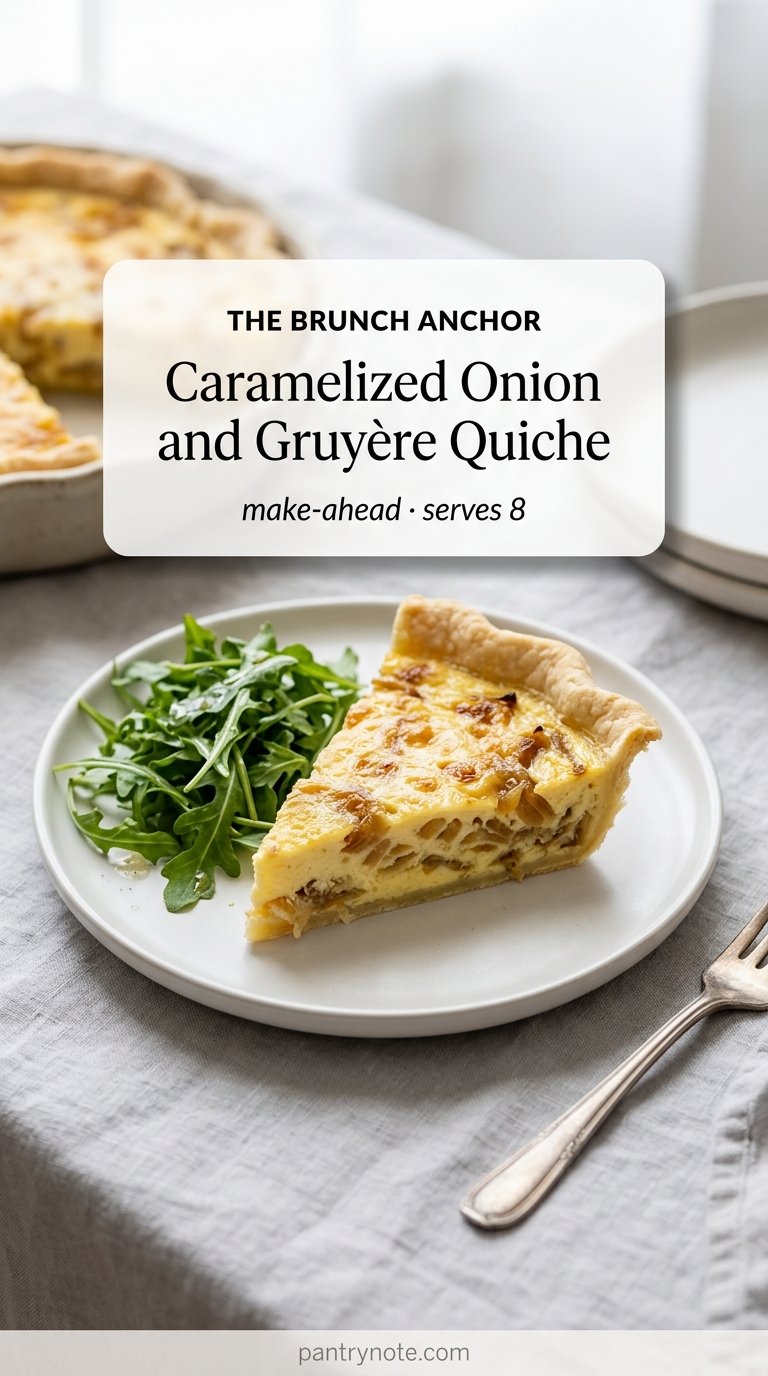
Caramelized Onion and Gruyère Quiche
Quiche has a reputation for being fussy, but the actual technique is straightforward once you understand the filling ratio. This one leans heavily on caramelized onions — an hour of slow cooking on the stove that produces an almost jammy, deeply sweet result — paired with nutty Gruyère in a flaky butter crust.
Quiche occupies an interesting place in home cooking: it sounds impressive, it photographs beautifully, it feeds a crowd effortlessly, and yet it's genuinely simple to make once you understand the filling-to-custard ratio that produces a set slice rather than a jiggly mess. The technique is mostly passive: the crust is mixed in minutes (or bought pre-made, no judgment), the filling takes time but not skill, and the oven does the real work.
The caramelized onions in this version take an honest hour to make. I say this up front because most recipes claim twenty minutes for caramelized onions and that is not caramelized onions, that is sautéed onions.
The difference is significant: truly caramelized onions are dark, jammy, almost sweet as candy, with a depth that comes from the Maillard reaction and caramelization running together over sustained heat. They reduce to about a quarter of their original volume.
They are extraordinary in a quiche.
Gruyère is the right cheese for this. Aged Swiss-style, with that particular nutty, slightly salty character that holds up to the richness of the egg custard and the sweetness of the onions. It melts smoothly, doesn't release excessive moisture, and provides both flavor and structure.
Why this works
Quiche is essentially a baked custard in a pastry shell. The custard sets through egg protein coagulation: the proteins in eggs denature and coagulate at temperatures between 149°F and 185°F, with the exact temperature depending on the ratio of eggs to cream and the presence of other proteins (cheese, vegetables).
Getting the custard right is a matter of ratio: too few eggs and it won't set; too many and it becomes rubbery and dry. The typical ratio for quiche is one whole egg plus one yolk per half cup of heavy cream, which produces a silky, just-set texture.
Blind baking (pre-baking the crust before adding filling) is the technique that prevents a soggy bottom. Raw pastry crust releases steam as it bakes (from the butter and any moisture in the flour).
If you pour liquid filling into an unbaked crust and bake together, the steam from the crust can't escape and the bottom remains raw or doughy. Blind baking for 15 minutes (with pie weights or dried beans to prevent puffing) sets the crust's structure before the filling goes in.
Caution with the oven temperature: too hot and the custard sets too quickly, producing a puffed, curdled result with tunnels. Quiche cooks best at a relatively low 325°F: the gentle heat allows the proteins to coagulate slowly and uniformly, producing a smooth, barely-trembling custard with no visible curdling. When the edges are set but the center still jiggles slightly (like Jell-O, not liquid), it's done; carryover cooking will finish the center during resting.
Ingredient notes
Onions
Sweet yellow onions or standard yellow onions. For a nine-inch quiche, start with four large onions; they reduce by 75% during caramelization.
The patience required is real but the result is irreplaceable. Cook them in butter over medium-low heat with just enough salt to draw out moisture, stirring every 5–10 minutes.
Do not rush with high heat, or you'll burn them before they caramelize.
Gruyère
Buy a wedge and grate it yourself. Pre-grated Gruyère often contains anti-caking agents and doesn't melt as smoothly. Look for Gruyère with an AOP designation if you want the Swiss original; domestic Gruyère-style cheese (like Roth Gruyère) is excellent and more widely available.
Cream
Heavy cream makes the richest custard. Half-and-half produces a lighter, slightly less silky result.
Whole milk works but the custard is firmer and more prone to becoming rubbery. Do not use low-fat cream or milk substitutes; the fat is what carries flavor and produces the smooth texture.
Pastry
Homemade shortcrust is flakier and more flavorful. The food processor method (cold butter, flour, ice water, pulse until shaggy) takes 10 minutes and produces excellent results. A good quality store-bought pie crust (Trader Joe's pie crust is one of the better ones) is entirely acceptable and saves 30 minutes of chill time.
Fresh herbs
Thyme leaves stirred into the custard add an herbal note that works with both the onions and the Gruyère.
How to make it
Start with the onions: always the onions first. Slice four large onions thinly.
Melt butter in your widest skillet over medium-low heat. Add onions with a pinch of salt.
Cook, stirring every 5–10 minutes, for 45 minutes to an hour. Adjust heat if anything is burning rather than caramelizing.
The onions will wilt, then steam, then begin to turn golden, then slowly darken to a deep amber-brown. When they look like something you'd pay extra for in a restaurant, they're done.
Make or prepare your pastry. Roll it into a 12-inch circle, fit into a 9-inch pie dish or tart pan, and trim the edges. Refrigerate for 20 minutes. Blind-bake at 375°F with pie weights for 15 minutes, then remove the weights and bake another 5 minutes until the base is pale gold and dry.
Whisk together eggs, yolks, cream, thyme, salt, pepper, and a pinch of nutmeg. Scatter half the Gruyère over the blind-baked crust.
Spread the caramelized onions over the cheese. Pour the custard over slowly.
Top with remaining Gruyère.
Reduce oven to 325°F. Bake 35–40 minutes until the edges are set but the center still trembles gently. Cool for 15 minutes before slicing.
Tips and variations
Make it ahead
Quiche is an ideal make-ahead dish. Bake completely, cool, wrap, and refrigerate for up to 3 days.
Reheat individual slices in a 325°F oven for 12–15 minutes. Serve at room temperature or just barely warm; it's excellent both ways.
Freeze it
Baked quiche freezes for up to 2 months. Wrap tightly and thaw overnight in the fridge before reheating.
Add other fillings
Sautéed mushrooms, blanched asparagus cut into small pieces, sun-dried tomatoes, or wilted spinach all work. Keep the total filling volume around 1.5 cups to avoid diluting the custard.
Make it with bacon
Lardons of bacon or pancetta cooked until crisp and added to the custard along with the onions turn this into something that might as well be called quiche Lorraine.
Individual portions
Use a muffin tin for individual quiches, filling two-thirds of the way and baking 18–22 minutes at 325°F.
Frequently Asked
My quiche is watery after slicing. What went wrong?
Can I make this gluten-free?
How do I know when the quiche is done?
How far ahead can I make this?
 Save
Save
0 Comments
No comments yet — start the conversation below.