

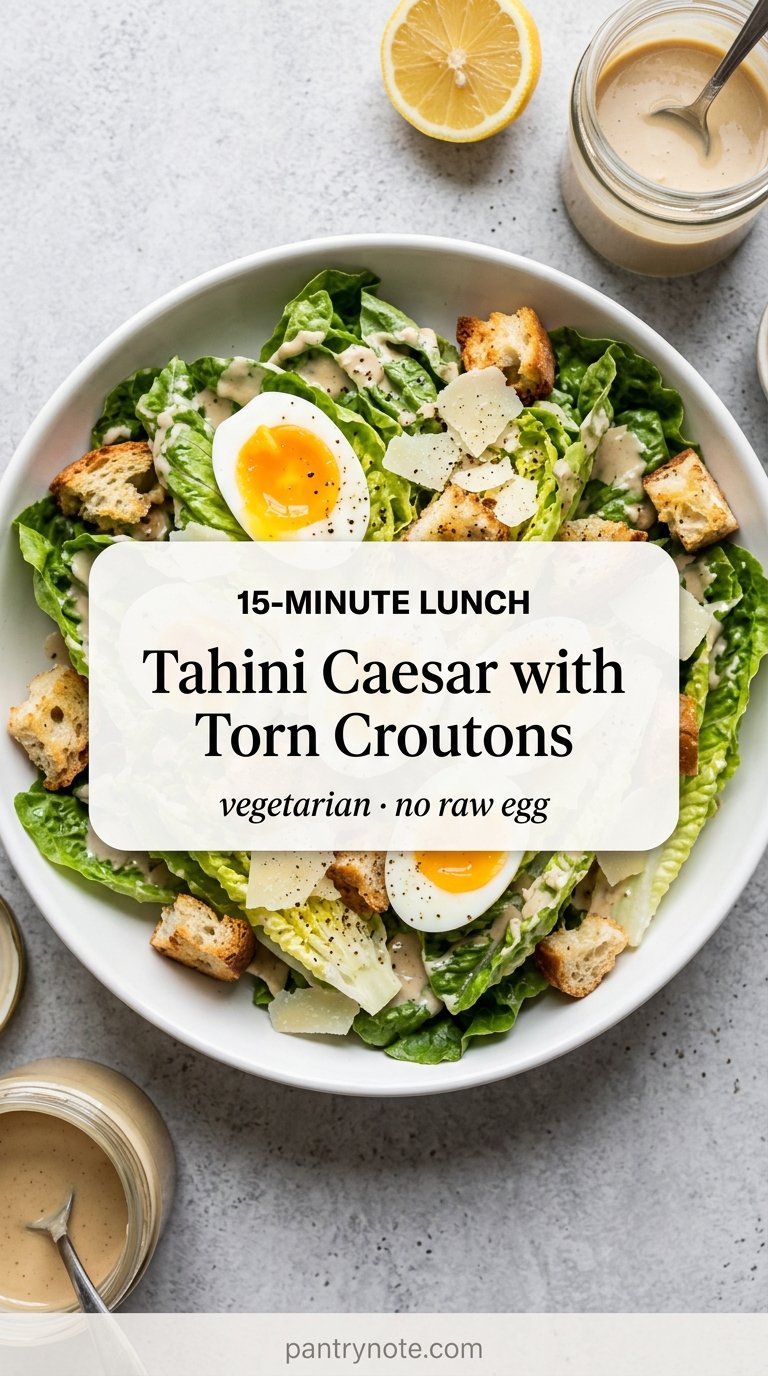
Tahini Caesar with Torn Croutons and Soft Eggs
This is not a Caesar in the strict sense, but it borrows everything good about a Caesar — the umami richness, the creamy dressing, the croutons, the Parmesan — and replaces the raw egg yolk and anchovy with tahini and a good amount of lemon. The result is a dressing you'll want to put on everything.
The classic Caesar debate (restaurants that make it tableside, arguments about whether anchovies are essential, disagreements about romaine versus other lettuces) tends to obscure what makes a good Caesar actually work. It's not the theater or the exact historical recipe; it's the combination of a rich, creamy, aggressively seasoned dressing against cool, sturdy lettuce and something crunchy on top. Everything else is detail.
This version swaps the raw egg yolk and anchovy for tahini (sesame paste), which provides both the richness and the savory depth through different means. Tahini is already an emulsified ingredient (oil suspended in ground sesame), so it thickens the dressing naturally without the yolk. And its flavor, nutty, slightly bitter, deeply savory, works in a dressing the way yolk and anchovy do: as background richness that makes everything taste more of itself.
The soft-boiled eggs are what I add instead of the raw yolk in the dressing: they bring both protein and a running yolk that mixes into the dressed leaves as you eat, enriching every bite. The torn croutons are made from whatever bread is going stale on the counter. Both are non-negotiable.
Why this works
Tahini is a pre-formed emulsion: sesame oil is suspended in a matrix of ground sesame solids, held in place by the sesame proteins and natural emulsifiers in the seeds. When you whisk tahini with an acid (lemon juice) and thin it with water, those emulsifiers continue to hold the mixture together while the texture shifts to something creamier and more dressing-like. This is the same principle that makes peanut butter work in dressings: the groundnut paste is doing the emulsification work that egg yolk does in a classic mayonnaise-based dressing.
Garlic in this dressing is treated differently from raw garlic chopped and added. Grating the garlic on a microplane creates a paste that distributes evenly and begins releasing its allicin compounds immediately. Then, letting the grated garlic sit in the lemon juice for a minute before adding other ingredients mellows the sharpest volatile compounds through acid exposure, leaving the flavor potent but not aggressive.
Parmesan, grated very fine, dissolves into the dressing and contributes glutamates. This is the texture-enhancing role in a classic Caesar that anchovies serve: both are high in glutamic acid, the amino acid that triggers umami perception. Omitting both (as in an all-vegetarian Caesar) produces a dressing that tastes flat by comparison; the tahini recovers some but not all of the depth.
For the croutons: tearing bread rather than cutting it produces irregular edges with more exposed interior surface area, which browns faster and more dramatically than cut cubes with smooth, sealed surfaces. Tossed in olive oil with garlic and salt and roasted hot (425°F), they develop exterior crunch and a hollow interior that stays crisp rather than becoming soggy when dressed.
Ingredient notes
Tahini
Soom is the benchmark brand: it's made from Ethiopian white sesame seeds and is noticeably smoother and less bitter than most grocery store brands. Seed + Mill is also excellent.
Avoid brands where the oil and solids have separated into an unworkable paste and hardened solids; stir thoroughly before measuring. The jar should pour smoothly when warmed.
Romaine
Inner romaine leaves are crisper, more tender, and less bitter than the outer leaves. Tear or cut into large pieces, not shredded. A good Caesar is eaten with a fork and knife, not a spoon.
Parmesan
Parmigiano-Reggiano, grated on the fine side of a box grater or on a microplane. Some goes into the dressing; more goes over the finished salad. Don't skip either application.
Bread for croutons
Day-old rustic bread, sourdough, ciabatta, or country loaf, is ideal. Tear it into irregular pieces roughly the size of a large marble. Don't use sandwich bread; it has too much sugar and too soft a crumb to produce good croutons.
Lemon
Fresh, always. The ratio of lemon to tahini in this dressing is higher than you might expect: lemon's role is to thin the tahini, add acid, and brighten the whole thing. Bottled lemon juice is too dull and one-dimensional.
How to make it
Start with the croutons; they need the most time. Tear your stale bread into rough pieces, toss with olive oil, a pinch of garlic powder, and salt.
Spread on a sheet pan and roast at 425°F for 10–12 minutes, turning once, until golden on most sides and hollow when tapped. Set aside.
For the soft eggs bring water to a boil, lower the eggs in gently on a spoon, and cook for exactly 7 minutes (for a just-set white and a creamy, jammy yolk). Transfer immediately to an ice bath. Peel once cool: the cold bath makes peeling easier.
For the dressing in a small bowl, grate one clove of garlic directly into the lemon juice. Stir and let sit for 60 seconds. Add the tahini, Worcestershire (for savory depth), Dijon, and a couple tablespoons of cold water. Whisk until smooth. The dressing will thicken significantly with the lemon juice; add more water, a tablespoon at a time, until it's pourable but still creamy. Season with salt and pepper.
In a large bowl, add the romaine and about two-thirds of the dressing. Toss well to coat every leaf.
Add the croutons and most of the Parmesan. Toss once more.
Divide into bowls, halve the soft eggs over each portion, and add the remaining dressing, Parmesan, and a generous crack of black pepper.
Tips and variations
Make-ahead dressing
The dressing keeps in the fridge for a week. Thin with water if it thickens. Excellent on roasted vegetables, grain bowls, or as a dip.
Add chicken
Grilled or roasted chicken breast sliced thinly on top. The tahini dressing is particularly good with chicken.
Use kale instead of romaine
Lacinato kale, de-stemmed and massaged with a little salt until slightly wilted, is sturdy enough to be dressed in advance without wilting. Makes excellent meal-prep lunches.
Make it heartier
Add chickpeas, roasted for crunch or straight from the can for ease.
Anchovy option
If you want the original umami depth, add 2–3 rinsed anchovy fillets to the dressing before blending. The tahini and anchovy together are even more complex.
Frequently Asked
Is Worcestershire sauce vegetarian?
Can I make the dressing without tahini?
How do I peel soft-boiled eggs cleanly?
Can I dress this salad ahead of time?
 Save
Save
0 Comments
No comments yet — start the conversation below.