

Slow-Cooked White Bean and Escarole Soup
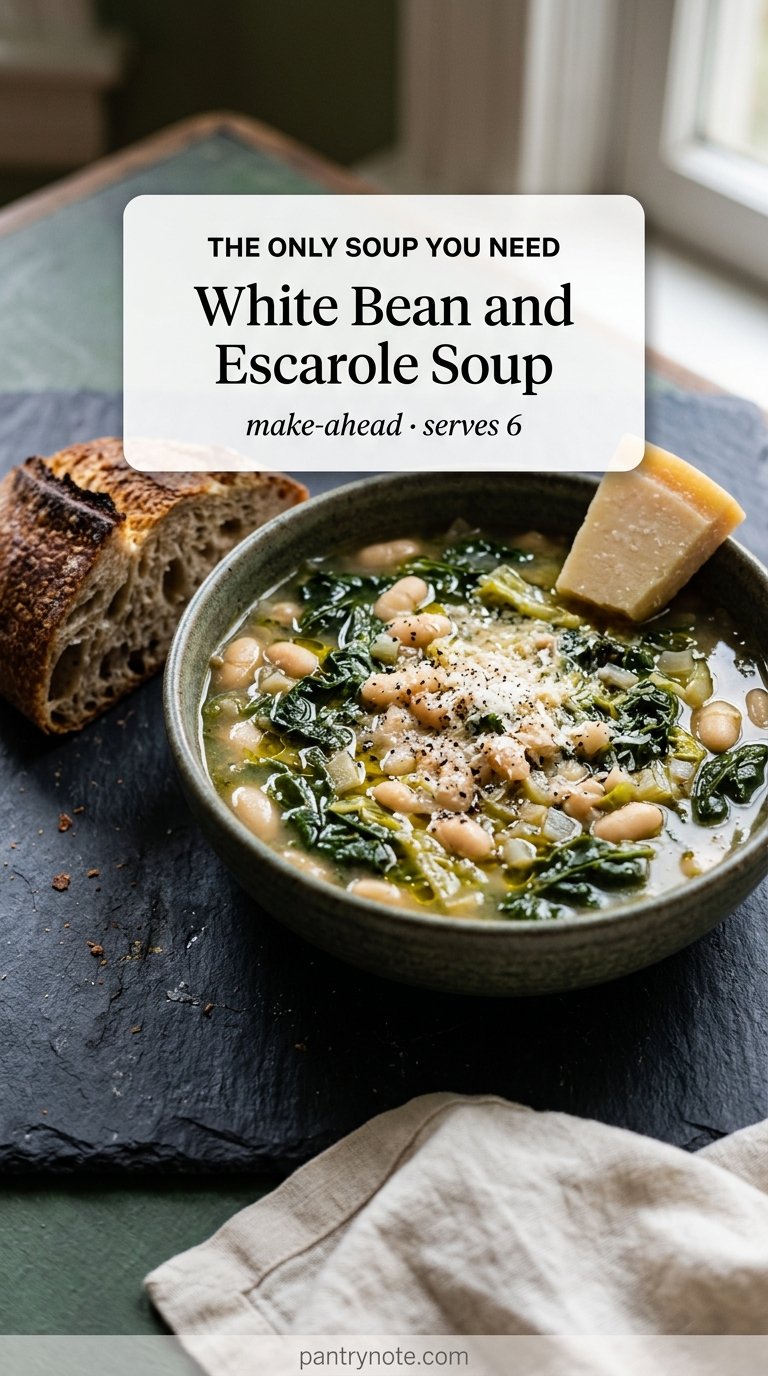
Some soups announce themselves the moment you walk in the door — this is one of them. The Parmesan rind turns the broth into something richer than you thought possible, and the escarole, which you might have been skeptical about, collapses into the beans in a way that feels inevitable.
White bean soup is the kind of recipe that feels ancient and immediate at the same time. Italians have been making versions of pasta e fagioli and ribollita for centuries: stretching beans through a week, adding stale bread, wilting whatever greens were on hand. This version is quieter than ribollita: fewer ingredients, longer cooking, a broth so savory it tastes like stock even though it's mostly water.
The Parmesan rind is the secret. Not the cheese itself, but the rind: the hard, waxy exterior that you normally throw away or forget about in the back of the cheese drawer.
Simmered in liquid for an hour or more, it releases glutamates (the same compounds responsible for umami in soy sauce and anchovies) and a deep, milky richness that makes the broth taste as though it spent hours reducing. Keep a bag in the freezer specifically for this purpose.
It's a free ingredient that transforms everything it touches.
Escarole is the green I come back to for soups every winter. It's in the chicory family, pleasantly bitter raw, but mellowing significantly with heat until it has a silky, almost tender quality.
If you haven't cooked with it before, this is the right introduction. It's forgiving, flavorful, and holds up in a soup without going to mush.
Why this works
Low and slow cooking does something to dried beans that no amount of time in a pressure cooker quite replicates. The beans gradually absorb liquid and swell evenly, their starches converting at a pace that gives the skins time to soften without bursting.
When you simmer them too aggressively, the skin splits before the interior is fully cooked, leaving you with mushy outsides and grainy centers. Low heat, just barely simmering, keeps the beans intact and cooking uniformly.
The mirepoix base (onion, celery, carrot in roughly equal parts) provides the aromatic backbone. These vegetables don't stay discrete in a long-cooked soup; they essentially dissolve over time, their sugars caramelizing slowly and their structure breaking down into the broth.
This is desirable. By the time the soup is done, you're not eating chunks of celery; you're tasting celery in every spoonful of broth.
A splash of white wine added after the aromatics soften picks up the fond (the browned bits at the bottom of the pot) and adds acidity that keeps the soup from feeling flat. Acids brighten fatty and starchy dishes by stimulating different taste receptors on the tongue. Without the wine, a bean soup can taste one-dimensional even if every individual element is correct.
Finally, the finishing technique matters: smashing a portion of the cooked beans against the side of the pot with a wooden spoon (or blending a cup and stirring it back in) releases their starch into the broth, thickening it naturally into something creamy and cohesive without any added thickener. This is ribollita logic applied gently.
Ingredient notes
Dried white beans
Cannellini are the standard choice here: they're creamy, large, and have a skin that holds up to long cooking. Navy beans work and cook slightly faster.
Borlotti beans have more earthy flavor and speckled color. Don't use canned beans for this recipe; the goal is a broth built from the beans themselves, and canned beans won't contribute the same starch content.
Escarole
Look for heads that are tight and fresh, not wilted or brown at the edges. The inner pale-yellow leaves are sweeter; the dark outer leaves are more bitter.
Use everything. If you genuinely can't find escarole, Tuscan kale (lacinato/cavolo nero) is the closest substitute since it's also slightly bitter and holds up to cooking.
Spinach is too delicate and will disappear; save it for last-minute additions.
Parmesan rind
If you don't have one on hand, the soup is still excellent without it, just a bit less complex. Some well-stocked grocery stores sell bags of rinds. A piece roughly 3 inches square is what you want.
Garlic
Several cloves, more than you think. Long-cooked garlic loses its pungency and becomes sweet and nutty; it's not the same as raw garlic's bite. Use 6–8 cloves for a full pot.
Extra-virgin olive oil
Use a decent bottle for finishing. The oil you drizzle over each bowl at the end is experienced directly on the palate, not cooked, so its quality is immediately apparent.
How to make it
Soak your beans overnight in cold water, at least 8 hours. This isn't strictly required (you can start from dry with a longer cook time), but it reduces cooking time by about 30 minutes and also helps with digestibility by leaching out some of the oligosaccharides that cause discomfort.
In your largest heavy-bottomed pot (a Dutch oven works perfectly), warm a generous pour of olive oil over medium heat and add diced onion, celery, and carrot. Cook these slowly, stirring occasionally, for about 15 minutes until soft and barely beginning to color.
Don't rush this. The mirepoix is building the base.
Add the sliced garlic and cook another minute. You'll smell it immediately: that sharp, bright garlic scent, before it mellows.
Add the white wine and listen to it sizzle. Scrape the bottom of the pot.
Let it reduce to almost nothing.
Add the soaked, drained beans, the Parmesan rind, a bay leaf, and enough water or light chicken stock to cover by two inches. Bring to a boil, then reduce to the barest simmer you can manage: a bubble every few seconds.
Cook with the lid slightly ajar for 1.5 to 2 hours, checking the beans at the 90-minute mark. You want them fully tender but still holding their shape.
Remove the Parmesan rind and bay leaf. Use a wooden spoon to mash roughly a quarter of the beans against the side of the pot.
Stir in the roughly chopped escarole. It'll look like a lot, but it wilts dramatically.
Simmer uncovered for another 15 minutes until the escarole is silky and the broth has thickened.
Season aggressively with salt, since bean soups need more salt than you expect because the beans absorb it. A good pinch of red pepper flakes goes in now or at the table.
Tips and variations
Add a Parmesan crust on top
Ladle the soup into oven-safe bowls, lay a slice of day-old bread on top, scatter grated Parmigiano over it, and broil until bubbly. This is essentially ribollita territory and it is wonderful.
Make it heartier
Stir in a cup of small pasta shapes (ditalini, tubetti) during the last 15 minutes of cooking. Add a bit more liquid as pasta absorbs it. This becomes pasta e fagioli.
Freezes beautifully
The soup without the escarole freezes well for up to 3 months. Add fresh escarole when reheating. Fully assembled soup can also be frozen but the greens lose their color and turn a bit drab, though it still tastes good, just not as pretty.
Make it meaty
Brown a piece of pancetta or a couple of Italian sausage links first, remove them, and build the mirepoix in the rendered fat. Return the meat to the pot with the beans.
Gremolata finish
A small spoonful of gremolata (minced lemon zest, garlic, and parsley) stirred into each bowl brightens the whole thing considerably.
Frequently Asked
Can I use canned beans to make this faster?
How long does this keep?
My beans are still chalky after 2 hours — what happened?
Can I make this in a slow cooker?
 Save
Save

0 Comments
No comments yet — start the conversation below.