

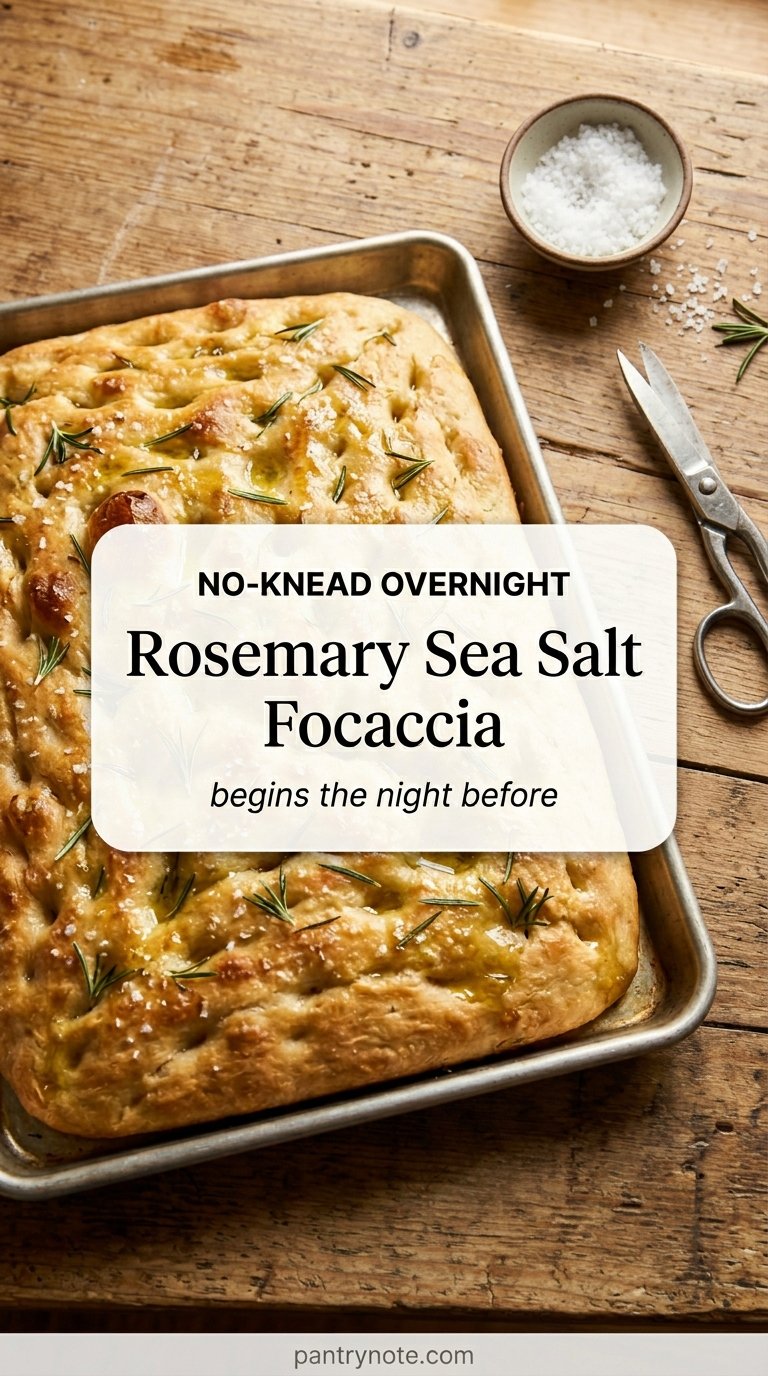
Overnight Focaccia with Rosemary and Sea Salt
This is the focaccia that convinced me that bread baking was for regular Tuesday people, not just weekend hobbyists. The overnight cold fermentation does the heavy lifting while you sleep, and the result — crackling base, soft airy crumb, pools of olive oil, flaky salt — is so good it's hard to justify buying it from a bakery ever again.
Focaccia is the bread that converts people. Not the dense, vaguely oily slab you sometimes get sliced in plastic bags at the deli counter, but proper focaccia: the kind that has a crackling, golden base from the olive oil pooled in the pan, a pillowy interior with irregular open crumb, and a top that's dimpled and glossy and scattered with flaky sea salt. This bread is what happens when you understand that olive oil isn't an ingredient in focaccia so much as a cooking medium.
The recipe I keep coming back to is a wet dough, no-knead approach with a long cold fermentation. You mix the dough in about five minutes the night before, put it in the fridge, and forget it.
The next morning, you transfer it to an oiled pan, let it spread and relax, then dimple and bake. The whole active process is maybe 20 minutes across two days.
The result is a bread with real, complex flavor, the kind that comes from time, not technique.
I make this when I'm having people over and want something homemade without the performance anxiety of a same-day loaf. It fits into the rhythm of a weekend the way few baking projects do.
Start it Friday evening; bake it Saturday morning while the coffee brews. Or start Saturday, bake Sunday for a brunch or early dinner.
Why this works
Wet doughs (high hydration; this one is around 80%) rely on time rather than kneading to develop gluten structure. In a lower-hydration dough, mechanical kneading aligns the gluten strands physically.
In a high-hydration dough, the water itself acts as a plasticizer, allowing the gluten proteins (glutenin and gliadin) to move freely and find each other naturally over time. Cold fermentation slows the yeast activity significantly but allows enzymatic activity (proteases and amylases) to continue working, breaking down some proteins and starches in ways that improve flavor complexity and dough extensibility.
The result of this slow, cold process is a dough that's both flavorful (from longer fermentation byproducts, including organic acids) and extensible (able to stretch without tearing as the carbon dioxide from yeast activity creates bubbles). Those large, irregular bubbles you see in a well-made focaccia crumb are carbon dioxide pockets that formed during fermentation and held their shape through baking.
The olive oil at the bottom of the baking pan serves two functions simultaneously. First, it conducts heat into the bottom of the bread more efficiently than air would, creating that crispy, almost-fried base that distinguishes proper focaccia from most bread.
Second, it prevents sticking so thoroughly that you can release the bread cleanly from even an un-lined pan. The oil that pools in the dimples on top also conducts heat into those spots, creating the characteristic golden craters.
Sea salt added just before baking dissolves partially on the surface during the early stages of baking, seasoning the crust directly. Flaky salt, Maldon or Jacobsen, provides both seasoning and textural contrast: those crunchy crystals that you hit as you bite through the crust.
Ingredient notes
Flour
All-purpose flour works well and is the pantry-friendly choice. Bread flour, with its higher protein content (12–14% vs. 10–12% for AP), will give you more structure and a slightly chewier crumb.
Both produce excellent focaccia; AP gives a more tender result, bread flour more resilience. Do not use cake flour: it doesn't have enough protein.
Yeast
Instant dry yeast (also called rapid-rise) is what I specify because it doesn't need to be bloomed in warm water first, so you can mix it directly with the dry ingredients. Active dry yeast works too; dissolve it in the warm water for 5 minutes before mixing. Use less than you think: cold fermentation with a small amount of yeast produces better flavor than fast fermentation with a lot.
Olive oil
Use good olive oil. This is a case where the quality of the oil is directly experienced: it's in the bread, it's cooking the base, it's on top.
California Olive Ranch extra-virgin is reliably excellent and widely available. A grassy, peppery oil like a Sicilian varietal adds a distinctive note.
Avoid the cheapest oils, which can turn bitter at baking temperature.
Sea salt
Two types: fine kosher salt in the dough for seasoning, and flaky finishing salt for the top. The flaky salt (Maldon is the gold standard; Jacobsen is excellent American-made) provides those crunchy crystals that make the crust irresistible.
Rosemary
Fresh, stripped from the stems and roughly chopped. Dried rosemary becomes dusty and slightly medicinal at high oven temperatures. If rosemary isn't your thing, fresh thyme, sage, or just plain sea salt and a drizzle of honey are all excellent alternatives.
How to make it
The night before, whisk flour, instant yeast, and salt in a large bowl. Add warm water (not hot, around 90°F, comfortably warm on your wrist) and a couple tablespoons of olive oil.
Mix with a rubber spatula until no dry flour remains. The dough will look shaggy and wet.
This is correct. Cover the bowl tightly with plastic wrap and refrigerate for 8–18 hours.
The next morning, the dough should look noticeably puffier and have bubbles visible through the bowl. Generously oil a quarter sheet pan (9×13) with about 3 tablespoons of olive oil.
Don't be shy; this oil is serving a structural purpose. Pour the dough out onto the pan.
It will be sticky and reluctant. Let it sit, covered loosely with plastic, for 2 hours at room temperature.
At the 2-hour mark, the dough should have spread significantly. Oil your fingertips and dimple the entire surface firmly, not timidly.
Push all the way to the bottom of the pan. This creates the characteristic surface texture and helps the oil pool in the craters.
Scatter rosemary and flaky salt generously.
Bake at 450°F for 20–25 minutes. At 20 minutes, check the color: you want a deep golden brown on top and, if you can peek under the edge with a spatula, a rich amber base. The bread will sound hollow when tapped on the bottom.
Let it cool on a rack for at least 10 minutes before cutting: the interior is still setting during this time.
Tips and variations
Topping variations
Sliced cherry tomatoes pressed into the dimples before baking burst and caramelize. Thinly sliced red onion and Kalamata olives are a classic combination. A post-bake drizzle of honey and flaky salt is unexpectedly wonderful.
Storing
Focaccia is best day-of but holds well wrapped at room temperature for up to 2 days. Reheat slices in a toaster or on a griddle rather than the microwave, since you want to re-crisp the base.
Sandwich focaccia
Let it cool completely, slice horizontally, and use for sandwiches. The crumb structure is sturdy enough to hold fillings without going soggy as quickly as regular bread.
Freeze it
Baked focaccia freezes well for up to a month. Thaw at room temperature and reheat in a 350°F oven for 10 minutes.
Same-day version
If you skip the fridge and let the dough rise at room temperature for 3–4 hours, you can still make excellent focaccia. It just won't have quite the depth of flavor from cold fermentation.
Frequently Asked
Can I halve the recipe?
Why is my focaccia dense?
How much olive oil is really necessary?
Can I add toppings other than rosemary?
 Save
Save


0 Comments
No comments yet — start the conversation below.